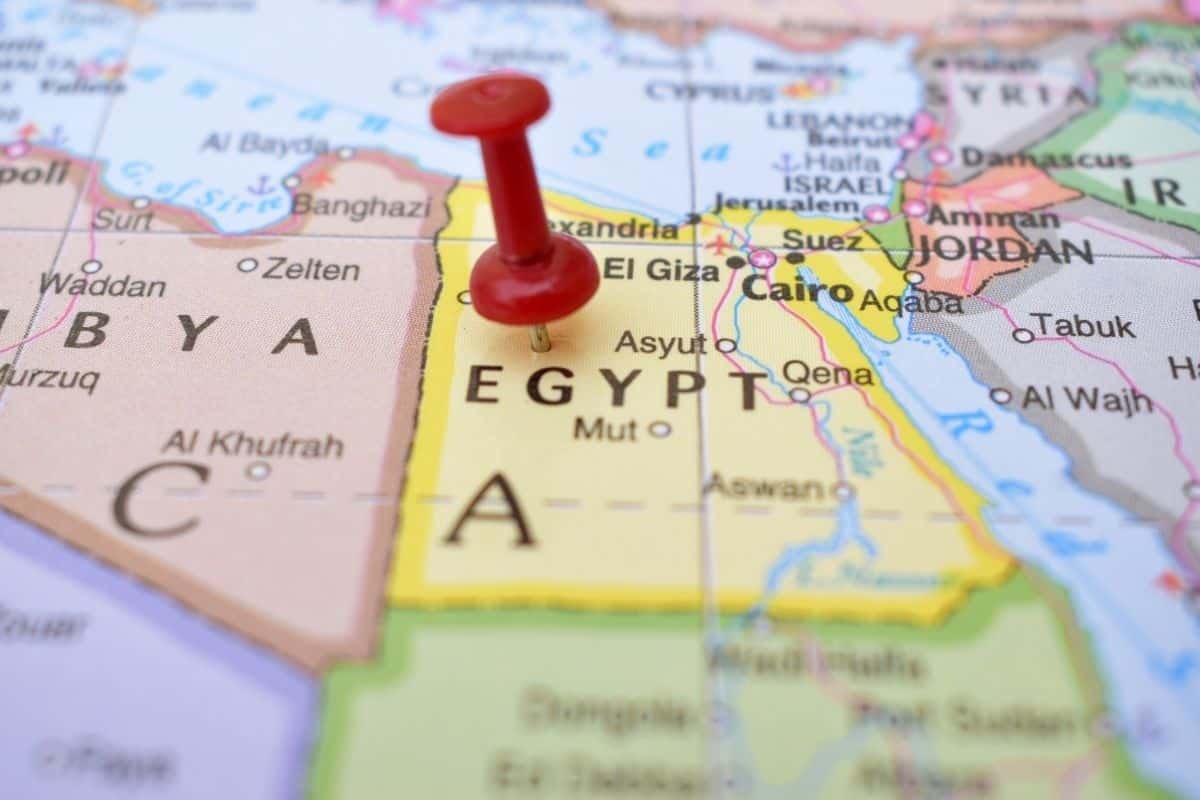
Understanding Egypt location, size and population gives travelers a better appreciation of the country’s geography, culture, cities, and unique way of life. Egypt occupies a strategically important position between Africa and Asia and is home to one of the world’s most distinctive population distributions.
From the Nile Valley and Delta to the vast Western Desert and the Sinai Peninsula, Egypt’s location, size and population have played a major role in shaping its history and continue to influence tourism, agriculture, transportation, and everyday life.
Location of Egypt
Egypt is located in the northeastern corner of Africa, while the Sinai Peninsula forms a land bridge between Africa and Asia. This makes Egypt a transcontinental country with territory in both Africa and Asia.
Egypt is bordered by the Mediterranean Sea to the north and the Red Sea to the east. It shares land borders with Libya to the west, Sudan to the south, and Israel and the Gaza Strip to the northeast.
The country’s geographical position has made it an important connection between Africa, Asia, and Europe for thousands of years. One of the most important features of Egypt’s location is the Suez Canal, which connects the Mediterranean Sea with the Red Sea and provides a major maritime route between Europe and Asia.
For tourists, where Egypt is located is particularly important because the country’s geography creates significant differences between destinations. Cairo sits in the north near the Nile Delta, while Luxor and Aswan are much farther south in Upper Egypt. Popular Red Sea destinations such as Hurghada and Sharm El Sheikh are located along Egypt’s eastern coastline.
Where Is Egypt Located?
Egypt is located in northeastern Africa, with the Sinai Peninsula extending into southwestern Asia.
Its geographical position can be summarized as follows:
- North: Mediterranean Sea
- East: Red Sea
- West: Libya
- South: Sudan
- Northeast: Israel and the Gaza Strip
- Between: Africa and Asia
This strategic Egypt location has helped make the country an important center of trade and civilization throughout history.
The Nile River is another defining geographical feature. It flows from south to north through Egypt before reaching the Mediterranean Sea. Much of the country’s population and agricultural activity is concentrated around the Nile Valley and Nile Delta.
Size of Egypt
Egypt covers approximately 1,001,450 square kilometres, making it a large country geographically. However, its enormous land area does not mean that most of the country is densely populated.
A very large proportion of Egypt consists of desert. The country’s major population centers and agricultural areas are concentrated around the Nile Valley and Delta, as well as several coastal and oasis communities.
When considering how big Egypt is, it is important to look beyond its total land area. Much of the country’s territory is arid desert, while the areas around the Nile support a much higher concentration of people and agriculture.
This unusual relationship between Egypt size and population distribution is one of the most important geographical facts for visitors to understand.
How Big Is Egypt?
Egypt’s total area is approximately 1 million square kilometres. The country stretches from the Mediterranean coast in the north to the border with Sudan in the south and from Libya in the west to the Red Sea and Sinai Peninsula in the east.
The country’s major geographical regions include:
- The Nile Valley
- The Nile Delta
- The Western Desert
- The Eastern Desert
- The Sinai Peninsula
- The Mediterranean and Red Sea coastlines
For travelers, Egypt’s large size means that destinations that appear relatively close on a map can still require several hours of travel by road, train, domestic flight, or organized tour.
Population of Egypt
Egypt has one of the largest populations in Africa and the Arab world. In 2026, Egypt’s population is around 118–120 million, depending on the source and population estimate used.
The country’s population is highly concentrated rather than evenly distributed across its territory. The overwhelming majority of Egyptians live in or near the Nile Valley and Nile Delta, where water and fertile agricultural land are available.
This creates a striking contrast between Egypt’s population and its size. Although the country covers roughly one million square kilometres, only a relatively small portion of its territory supports the vast majority of its population.
Egypt Population Distribution
Understanding Egypt population distribution is particularly useful for tourists because it explains why some parts of the country are densely populated while others appear almost completely empty.
The Nile is the main reason for this pattern. For thousands of years, Egyptian communities have depended on the river for water, agriculture, transportation, and settlement.
The Nile Valley forms a relatively narrow inhabited corridor through the desert. North of Cairo, the river spreads into the fertile Nile Delta before reaching the Mediterranean Sea.
Major population centers include Cairo and Greater Cairo, Alexandria, Giza, Port Said, Suez, Luxor, and Aswan.
Greater Cairo is by far the country’s most prominent metropolitan area and is one of the largest urban concentrations in Africa and the Middle East.
Why Is Egypt’s Population Concentrated Along the Nile?
The answer is closely connected to geography.
Most of Egypt is desert, with extremely limited rainfall. The Nile provides a reliable source of freshwater and has historically made agriculture possible in an otherwise arid environment.
As a result, settlements developed along the river and its delta. Over thousands of years, these settlements grew into towns, cities, and one of the world’s great centers of civilization.
Today, the same geographical pattern remains visible. A visitor traveling away from the Nile Valley can quickly encounter vast desert landscapes, while the areas close to the river can be highly urbanized and densely populated.
Egypt Location, Size and Population: Key Facts
Here are the main facts tourists should remember about Egypt location, size and population:
| Fact | Information |
|---|---|
| Location | Northeastern Africa, with the Sinai Peninsula in Asia |
| Approximate area | 1,001,450 km² |
| Northern border | Mediterranean Sea |
| Eastern coast | Red Sea |
| Western neighbor | Libya |
| Southern neighbor | Sudan |
| Northeastern neighbors | Israel and the Gaza Strip |
| Major river | Nile |
| Population in 2026 | Approximately 118–120 million |
| Main population concentration | Nile Valley and Nile Delta |
| Major metropolitan area | Greater Cairo |
How Egypt’s Geography Affects Tourism
The relationship between Egypt location, size and population has a direct effect on travel planning.
Cairo and Giza are located in the north, while Luxor and Aswan are much farther south along the Nile. Popular Red Sea resorts are located east of the Nile Valley, and destinations such as Sharm El Sheikh require travel across the Sinai Peninsula.
This means tourists should consider transportation time when creating an Egypt itinerary. A trip covering Cairo, Luxor, Aswan, and the Red Sea involves significant distances, even though all these destinations are within the same country.
Egypt’s geography also explains the variety of landscapes travelers can experience. A single trip can include ancient monuments beside the Nile, enormous desert landscapes, Mediterranean beaches, and coral-rich Red Sea coastlines.
Is Egypt in Africa or Asia?
Egypt is primarily located in Africa, but the Sinai Peninsula is geographically part of Asia. For this reason, Egypt is often described as a transcontinental country.
The Suez Canal separates the African mainland from the Asian Sinai Peninsula while also serving as one of the world’s most important shipping routes.
For tourists, this geographical detail makes Egypt’s location especially interesting because the country forms a natural connection between two continents.
Egypt’s Location and the Nile River
The Nile is central to understanding Egypt location, size and population.
The river runs through the country from south to north and eventually reaches the Mediterranean Sea. Ancient Egyptian civilization developed around the Nile because it provided water, transportation, and fertile land.
Many of Egypt’s most famous tourist destinations are connected to the river. Cairo and Giza are located near the northern part of the Nile system, while Luxor and Aswan lie farther south.
Nile cruises are also one of the most popular ways for visitors to experience the country’s archaeological sites and landscapes.
Why Egypt’s Size Matters for Tourists
Egypt’s large geographical area can be misleading because most visitors spend their time within a relatively small number of populated and tourist regions.
The main destinations for international travelers include Cairo and Giza, Luxor, Aswan, the Red Sea resorts, Alexandria, and parts of the Sinai Peninsula.
Travel times between these destinations can vary significantly. Domestic flights can save time on longer journeys, while trains, buses, private transfers, and Nile cruises provide other options depending on the itinerary.
Understanding how big Egypt is before booking a trip can therefore help travelers build a more realistic schedule.
Final Thoughts on Egypt Location, Size and Population
The combination of Egypt location, size and population helps explain much of what visitors see when they travel through the country.
Egypt occupies a unique position in northeastern Africa, with the Sinai Peninsula extending into Asia. It covers approximately 1,001,450 square kilometres, yet most of its population is concentrated in a relatively narrow area around the Nile Valley and Delta.
With a population of roughly 118–120 million in 2026, Egypt is one of Africa’s and the Arab world’s most populous countries. Its deserts, Nile landscapes, major cities, ancient monuments, and Red Sea coastline make its geography particularly diverse.
For tourists, understanding Egypt’s location, size and population before visiting can make it easier to plan transportation, choose destinations, estimate travel times, and appreciate the geographical setting behind some of the world’s most famous ancient sites.