Pyramids of Giza: Egypt’s Timeless Ancient Wonders
Pyramids of Giza are among the most iconic and mysterious monuments ever built by humankind. Rising from the edge of the Sahara Desert just outside modern-day Cairo, these colossal stone structures have fascinated historians, archaeologists, and travelers for over 4,500 years.
As the last surviving wonder of the ancient world, the Pyramids of Giza stand as a powerful symbol of ancient Egyptian ingenuity, spiritual belief, and architectural brilliance. In this article, we’ll explore their history, purpose, construction theories, and why they continue to captivate millions of visitors every year.
Table of Contents
Where Are the Pyramids of Giza Located?
The Pyramids of Giza are located on the Giza Plateau, approximately 15 kilometers southwest of central Cairo, Egypt. Positioned on the west bank of the Nile River, the site was chosen for its elevated limestone bedrock, which provided a stable foundation for massive construction.
Their strategic placement also held spiritual significance. In ancient Egyptian belief, the west was associated with death and the afterlife, making it the ideal location for royal tombs.
The Three Main Pyramids of Giza
The Great Pyramid of Khufu (Cheops)
The Great Pyramid of Khufu is the largest and most famous of the Pyramids of Giza. Originally standing at 146.6 meters tall, it was the tallest man-made structure in the world for nearly 4,000 years.
Built around 2580 BC, this pyramid is made from an estimated 2.3 million limestone blocks. Its precision continues to amaze modern engineers.
The Pyramid of Khafre (Khepren)
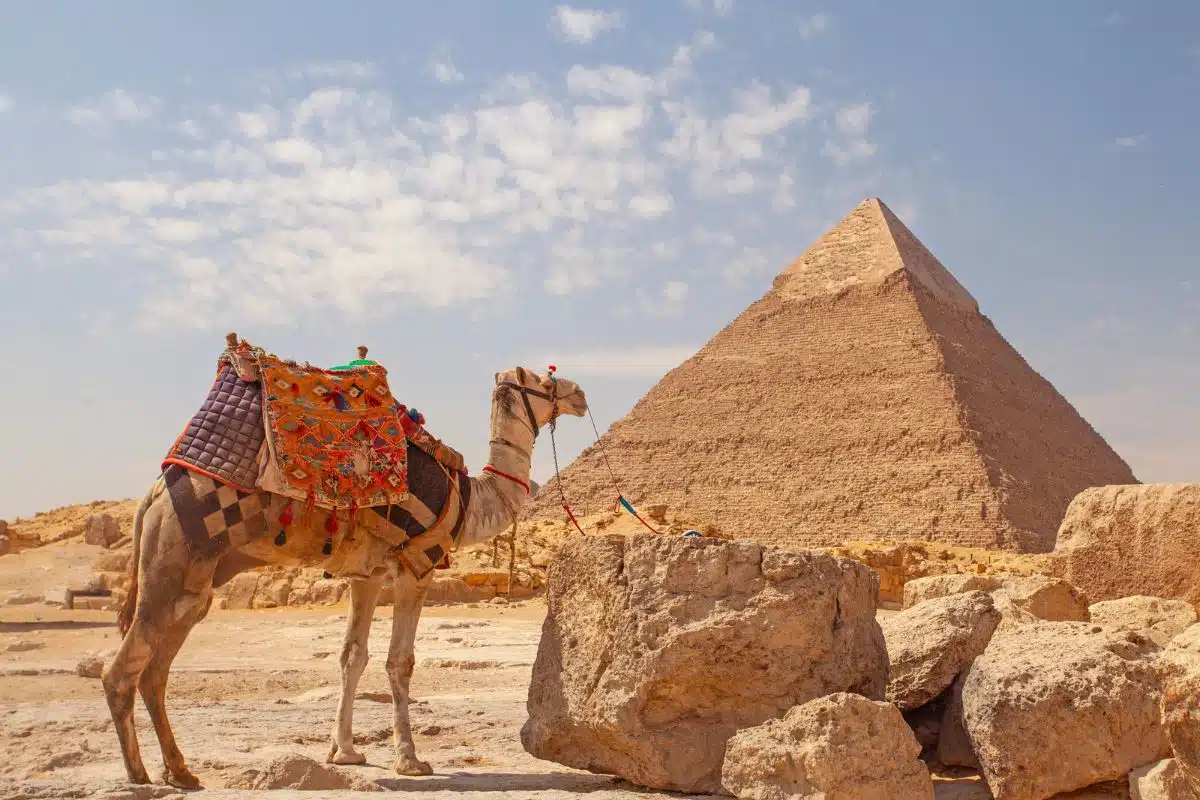
The Pyramid of Khafre appears taller than Khufu’s due to its elevated position, although it is slightly smaller. It is the only pyramid that still retains part of its original smooth limestone casing at the top.
Khafre’s pyramid is closely associated with the Great Sphinx, which is believed to bear his likeness.
The Pyramid of Menkaure
The Pyramid of Menkaure is the smallest of the three but is notable for its refined construction. Parts of its lower casing were made from red granite, adding a distinctive visual contrast.
Who Built the Pyramids of Giza?
Contrary to popular myths, the Pyramids of Giza were not built by slaves. Archaeological evidence shows they were constructed by skilled Egyptian labors who lived in nearby workers’ villages.
These workers were well-fed, organised into crews, and likely proud to contribute to monuments built for their divine kings. The pyramids served as royal tombs, designed to help pharaohs ascend to the afterlife and unite with the gods.
How Were the Pyramids of Giza Built?
<a id=”how-built”></a>
The exact construction methods of the Pyramids of Giza remain one of history’s greatest mysteries. However, most scholars agree on several key points:
-
Limestone blocks were quarried locally
-
Granite blocks were transported from Aswan
-
Ramps, sledges, and manpower were used to move stones
-
Construction took decades, not centuries
Recent discoveries, including ancient papyri, support theories that the stones were transported via canals connected to the Nile.
The Great Sphinx of Giza
Standing guard over the plateau is the Great Sphinx of Giza, a colossal limestone statue with the body of a lion and the head of a pharaoh. Measuring over 73 meters long, it is one of the largest monolithic statues in the world.
The Sphinx symbolized strength, wisdom, and royal power. Despite centuries of erosion and damage, it remains one of the most recognizable monuments on Earth.
Why the Pyramids of Giza Still Matter Today
The Pyramids of Giza are more than ancient tombs — they are a testament to human ambition, creativity, and belief. They reflect a civilization that mastered mathematics, astronomy, and engineering long before modern technology existed.
Today, they continue to inspire:
-
Historians seeking answers
-
Architects studying precision
-
Travelers chasing wonder
-
Cultures connecting with the past
They are also a powerful reminder of Egypt’s enduring cultural legacy.
Visiting the Pyramids of Giza
Visiting the Pyramids of Giza is a once-in-a-lifetime experience. Early morning visits are highly recommended to avoid crowds and heat.
You can explore:
-
The exterior of all three pyramids
-
The Great Sphinx
-
Panoramic viewpoints
-
Optional interior chambers
See it with a local guide: Private Pyramids Tour · Quad Bike Tour at the Pyramids. Questions? WhatsApp Mo.